“La sélection variétale s’est longtemps concentrée sur le rendement, en négligeant ce qui se passe sous terre. Or c’est à l’interface racines-sol que la plante puise toute son eau et tous ses nutriments.” précise Pierre Rochepeau.
EU - Phenotyping, genotyping, modelling: a toolbox for root-based plant breeding

Challenge
Roots play a decisive role in plant growth and adaptation to environmental constraints, particularly the availability of water and nutrients. However, because their development occurs largely underground, it remains difficult to observe and characterize. Gaining a better understanding of the diversity of root systems and how they function is therefore a key objective for varietal selection and the development of more resilient crops.
Roots: a strategic lever for breeding
Climate change is subjecting European crops to increasing water and nutrient stress. Having resilient varieties is becoming central to securing production.
Yet one lever remains largely underused in breeding schemes to date: roots. Decisive for access to water and nutrients but difficult to observe at scale, they have long remained in the background of plant breeding.
Building on the Solace project, Root2Res, co-coordinated by ARVALIS and the James Hutton Institute (Scotland), sets out to fill this gap by building an integrated approach to root characterisation for plant breeding.
Combining data and models to guide breeding
The project delivers three complementary toolboxes.
The phenotyping toolbox, led by ARVALIS, provides tools (such as a scanner-based minirhizotron and root pits) to observe roots. Furthermore, genotyping enables the development of molecular markers that link root traits to genetics, thereby improving prediction and selection. Lastly, modelling offers algorithms to simulate a cultivar’s performance across different types of environment, drawing on substantial envirotyping work to make that performance objective.
These three building blocks rely on the prior characterisation of an ‘identikit’ of an ideal variety in a given environment, known as a root ideotype. Co defined with farmers and breeders, it sets a breeding objective for the sector.
200
varieties tested
100 kg
of carbon/ha/year: the sequestration target of the new varieties developed
More resilient varieties in the face of climate change
Highlighted by the European Commission as a project contributing to its 2050 climate-neutrality objectives, Root2Res provides breeders, researchers and agronomists with new tools and experimental methods in the short term to design cropping systems suited to varied and changing environments.
By linking root traits, genetics and environmental conditions, these toolboxes will guide the development of varieties more resilient to the water and nitrogen stress associated with climate change, and of cropping systems that store more carbon and use fewer inputs. Farmers will be the end beneficiaries.
A deeper, denser root system has greater potential to store carbon in the soil, notably as biomass By exploring the soil better and capturing water and nitrogen more efficiently, these varieties will also make it possible to produce with less mineral nitrogen fertiliser, reducing nitrous oxide emissions from fertilised soils as well as those linked to their manufacture.
As the first targets of these tools, the aim is for breeders to develop varieties which, within five to ten years, will be grown by nearly 10% of European farmers.
Article based on an interview with Pierre ROCHEPEAU, an engineer and R&D project manager at ARVALIS.
Find out more
What do European projects actually deliver for farmers and agri-food sectors?
With its booklet “Agricultural Technical Institutes at the Heart of Innovation in Europe – Solutions for Agri-food Sectors”, Acta showcases the results of its collaborative projects and how they are put into practice in the field.
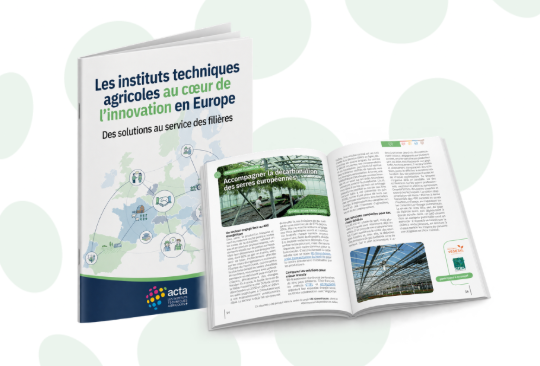
Produced by the Europe Department in collaboration with the network’s agricultural technical institutes, this publication showcases tools, methods and resources that support the transition of the agricultural and forestry sectors.
Télécharger le livret