“Knowledge creates value only when it reaches the people who can use it and is put into actual practice.”
From European Projects to Solutions for the Field
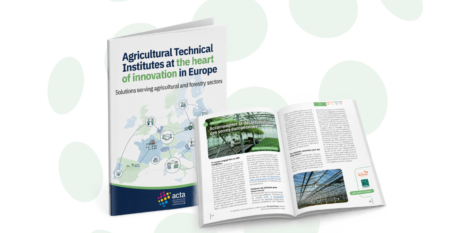
With the publication “Agricultural Technical Institutes at the Heart of Innovation in Europe – Solutions for Agricultural Sectors”, Acta showcases the results of its collaborations and how they are being used in practice. Produced by Acta’s Europe Department together with the agricultural technical institutes in its network, this publication highlights tools, methods and references that support agricultural and forestry transitions.
Download the booklet
Turning research into practical solutions
An educational game to support integrated crop protection strategies, a decision-support tool to decarbonise heated greenhouses, a toolkit to strengthen biosecurity in poultry farming… Behind these solutions are collaborative European projects with a common objective: turning research knowledge into practical responses to professionals’ needs.
Unique in Europe, the Acta network brings together agricultural technical institutes from across different production sectors and value chains, bridging the gap between research, innovation and practice. Through European programmes such as Horizon Europe, LIFE, Erasmus+, Interreg and COST, agricultural technical institutes work with European partners to develop and test practical solutions for stakeholders across the agricultural ecosystem. Firmly rooted in the realities of agricultural sectors, they help turn knowledge into tools, methods and references that can be directly put into practice.
Acta supports this involvement from project development through to implementation. Since 2014, these efforts have enabled the network to participate in more than 145 European projects.
European collaboration delivering tangible benefits for agricultural sectors
As the European Commission publishes its new AgRI 2040 and Food 2040 strategies, the booklet uses concrete examples to illustrate how research and innovation contribute to agricultural and food transitions at European level. Climate change, farm competitiveness, digital agriculture, the agroecological transition and biodiversity, animal health and welfare: the publication presents a range of achievements through the voices of those who developed them.
In her editorial, Agata Gulisano, Research Program Officer Agricultural Knowledge and Innovation Systems (AKIS) DG Agriculture and Rural Development European Commission, highlights the role of applied research:

European collaborations create opportunities to share experiences across countries, learn from different approaches and accelerate the uptake of innovation. As explained by Pacôme Elouna Eyenga, Team Leader | EIP-AGRI SF, European CAP Network, Support Facility for Innovation and Knowledge exchange | EIP-AGRI:

These synergies between local, national and European levels strengthen the technical institutes’ ability to respond to farmers’ needs and disseminate solutions tailored to the realities of different territories.
Sustaining impact beyond the projects themselves
Beyond the achievements presented, the booklet puts forward several recommendations for policymakers. It stresses that the impact of European investment depends not only on the quality of the results produced, but also on the conditions that enable their dissemination, uptake and large-scale deployment.
This means approaching funding as a long-term pathway rather than a succession of isolated projects, strengthening the multi-actor approach from the design stage of calls for proposals, supporting the dissemination and uptake of results beyond the duration of individual projects, and recognising the essential role of intermediary actors who support the implementation of innovations in the field.
Finally, the examples presented in this booklet show that impact does not begin when results are published: it is built throughout the entire project. Involving users from the design stage, working with advisers and other field-based stakeholders, testing solutions in real-world conditions and preparing for their dissemination are all essential to support their uptake.
For several years, Acta and the agricultural technical institutes have been developing this approach, focused on the uptake of results and the transformation of knowledge into practical solutions for farmers and agricultural sectors. This is one of the key lessons emerging from the European projects presented in the booklet.
A publication for everyone involved in decision-making, advisory services and driving agricultural innovation, offering an insight into how European collaborations translate into useful solutions for agricultural sectors.
Download the booklet
Editorial coordination
Camille Julia-Aubert, Léa Tourneur, Pauline Gay and Sonia Ramonteu — Acta.