From European Projects to Solutions for the Field
Read more
Challenge
In the face of food system sustainability challenges, how can we reconcile nutritional quality with a reduced environmental footprint? With Foodbasket7, IFIP is developing a tool to assess weekly food baskets against both criteria. This approach connects agricultural production, food processing and consumer choices.
Shaping the future of agri-food supply chains means addressing both environmental challenges and societal expectations, particularly in the livestock sector. This is the aim of the European PATHWAYS project, which seeks to co-develop pathways towards more sustainable livestock farming systems in collaboration with stakeholders on the ground.
Beyond these scenarios, another challenge is emerging: providing consumers with a tool that assesses both the nutritional quality and the environmental footprint of their diet, based on their weekly food basket. For IFIP, an institute working across the agricultural and agri-food sectors of the pig industry, nutrition is a key issue, as it helps shed light on how consumers perceive and choose food products. Numerous research projects carried out through national applied research networks explore this topic. With Foodbasket7, IFIP is building a bridge between production and consumption.
Foodbasket7 is a free, publicly accessible web application that assesses weekly diets from both a nutritional and an environmental perspective. Users enter their profile (age, sex and activity level) before building their food basket. The tool then provides a two-dimensional assessment: how well their nutritional requirements are met and the environmental footprint of their food basket.
Users can then modify the foods and quantities, compare different scenarios and observe how these changes affect the results. To perform these calculations, Foodbasket7 draws on several databases, including AGRIBALYSE and CIQUAL, developed at the French national level with contributions from agricultural technical institutes. It also builds on and extends the expertise developed by this network at the European level.
Launched online in late 2025, Foodbasket7 is still in its first version, and users are only beginning to explore its potential. Originally designed for the general public, it is also attracting a more professional audience, particularly researchers who are using it as a tool for modelling and exploring different scenarios.
The application could serve as a research platform, providing researchers with a ready-to-use interface for conducting studies on food consumption. It could also be rolled out internationally and adapted to each EU country, with country-specific foods and environmental impact data reflecting local conditions. This could become possible through the European FOODTURE project, which aims to build a continent-wide database, following the example set by France’s AGRIBALYSE initiative.
Foodbasket7 could therefore be just the starting point for a broader range of applications and a series of follow-up European projects, supporting agri-food sectors by enabling research to progress over the long term.
Like other tools, it contributes to the overarching goal of PATHWAYS: supporting the transition of the sector from farm to fork.

This article is based on an interview with Pierrick Girard, Environmental Assessment and Eco-design Research Engineer at IFIP.
Find out more
With its booklet “Agricultural Technical Institutes at the Heart of Innovation in Europe – Solutions for Agri-food Sectors”, Acta showcases the results of its collaborative projects and how they are put into practice in the field.
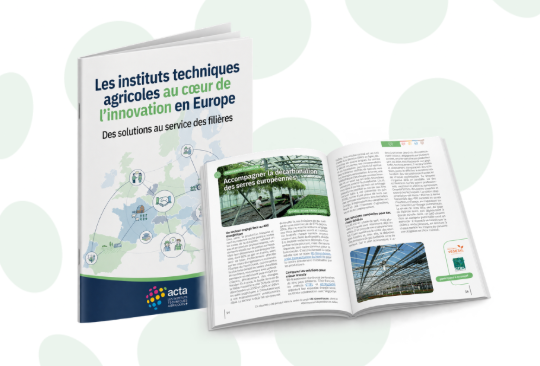
Produced by the Europe Department in collaboration with the network’s agricultural technical institutes, this publication showcases tools, methods and resources that support the transition of the agricultural and forestry sectors.